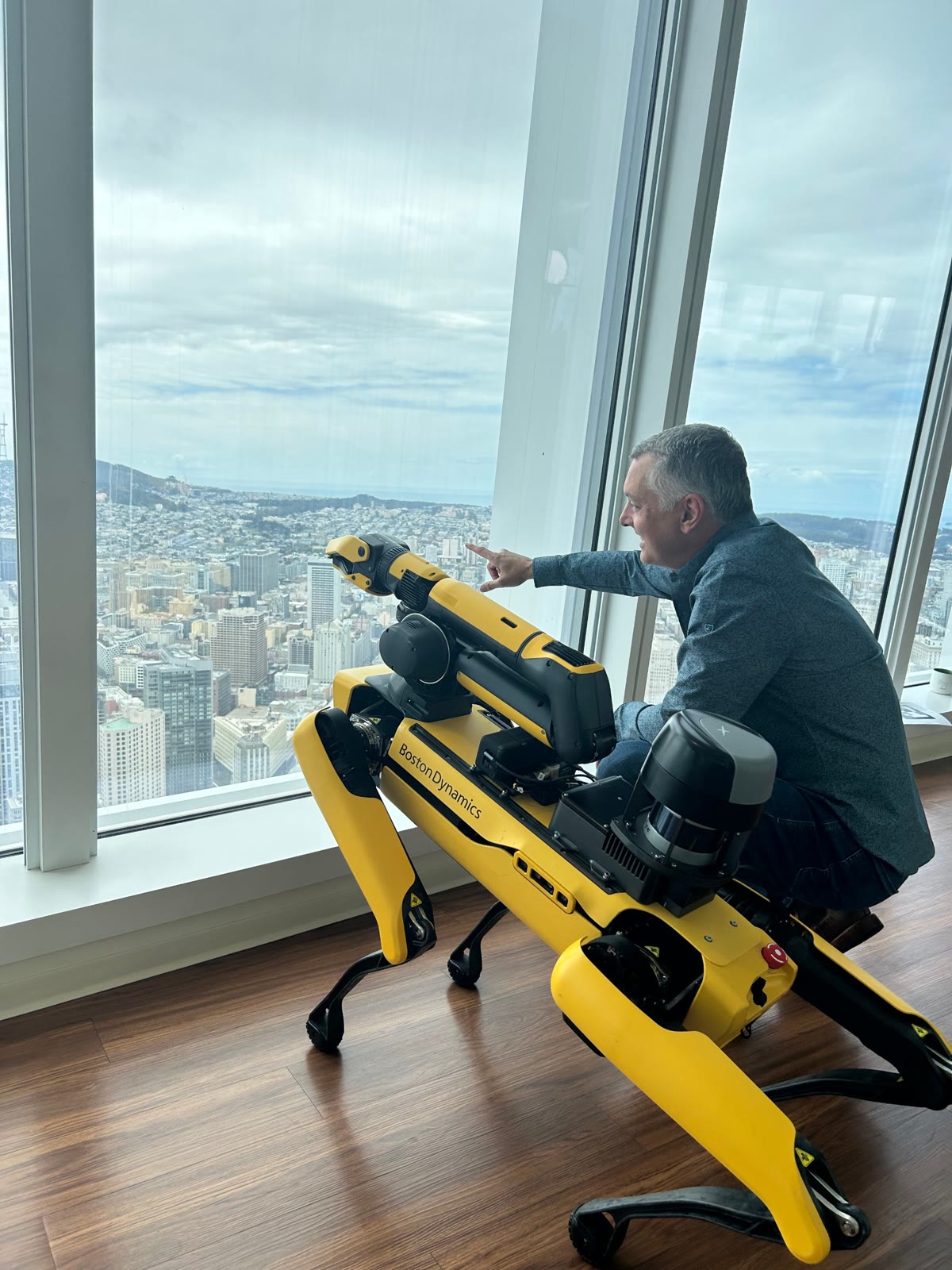
Joe Andolina kneeling beside a Boston Dynamics Spot robot at a window high above San Francisco, pointing out at the city
Joe AndolinaTechnical and architectural leadAI · Software · Physical computing

I build
the first one.

The prototype is the argument. Production is the proof.

I'm usually the one on the team who takes the technical deep dive, builds the proof of concept, and then gets everyone else building with it. Over 25 years that's meant computer vision in Adobe Creative Cloud, connected cars wired to Salesforce, robots that take orders from AI agents, and agentic tools teams use every day.

Try the live agents
Live agents

Think it, see it.

Describe a gadget you wish existed. A small team of AI agents plans it, renders it, checks its own work, and tries again if it misses.

4 agents

Concept

How I work

How a project usually goes.

  1. Take the deep dive

    Whether it's a request or an idea of our own, I dig into the new technology first and figure out what it can really do.

  2. Build the proof of concept

    Hardware, software, or both, built fast enough that the team can react to something real.

  3. Bring the team along

    Walk people through how it works and train them up, so the project doesn't depend on me.

  4. Put it to work

    On a keynote stage, in a customer meeting, or in a tool people use every day. What doesn't hold up becomes a lab note.

Years building production software
25+
Patents in computer vision, adaptive AI interfaces, and accessibility
15
People who used Adobe Shape
4M
Assets generated with Brand Engine
40K+
Selected work

Demos that went somewhere.

Some of these started as a request and some as an idea we couldn't let go of. All of them ended up in front of real people, and some of it became product.

Why so many robots?

I'm on Salesforce's demo team, so a lot of what I build is made for a stage, and robots and cars show better than code. Every one of these runs on software built end to end: services, APIs, data, cloud, and the interface people touch. Plenty of my work has no hardware at all, like the agentic internal tools just below.

Software only

Agentic and AI tools that teams inside Salesforce use every day. They're internal, so here's what they do and what they're built on instead of screenshots.

Brand Engine

On-brand assets, generated on demand.

A multi-model AI pipeline (LLMs, diffusion, and vision models, plus fine-tuned LoRAs) that creative teams across Brand, Studio, Keynote, and Demo use to generate assets. Long-running jobs, sharing, access control, and retries are all handled.

200+ users · 40,000+ assets generated

PythonFastAPIReactTypeScriptPostgresRedis + RQS3 + CloudFrontOkta SAMLMCP serverpytest · Vitest · jest-axe
Pulse Insights

Feedback on the message before it goes on stage.

Built for Salesforce's User Insights team in support of Global Marketing Messaging. It turns research into synthesized analysis and recommendations, surfaced through dashboards and reports, on what the keynotes tell customers and the public.

Lightweight on purpose: no frontend framework, no build step

Node.jsFastifyPostgresBackground workerS3Okta SAMLfal.aiGoogle AI
Lab notes

The experiments that broke. I keep them because they taught me more than the ones that didn't.

WIRED on iPad · 2010

Rejected the day before launch.

Apple turned down the first WIRED iPad edition under a new rule against interpreted code. We took a long weekend, rewrote the whole app in Objective-C, and it shipped.

Now I treat platform rules as an architecture risk, and keep model providers pluggable.

Smart speaker puppet

Perfect in every test, silent at rehearsal.

A gutted smart speaker turned digital puppet lost its 2.4GHz link once it was surrounded by cameras, operators, and their comms. I rebuilt it on LoRa at 915MHz and it worked on show day.

Now I test in the room the thing will live in, as early as I can.

Writing
  1. 01

    AI Doesn't Have a Model Problem. It Has an Architect Problem.

    Nobody owns the space between a model and the person it serves.
    Essay
  2. 02

    Physical AI Doesn't Have a Model Problem. It Has a Reliability Problem.

    What collapses on stage isn't the brain. It's everything around it.
    Essay
  3. 03

    Digital Transformation Doesn't Have a Strategy Problem. It Has an Ownership Problem.

    Most AI pilots stall for lack of an owner, not a model.
    Essay